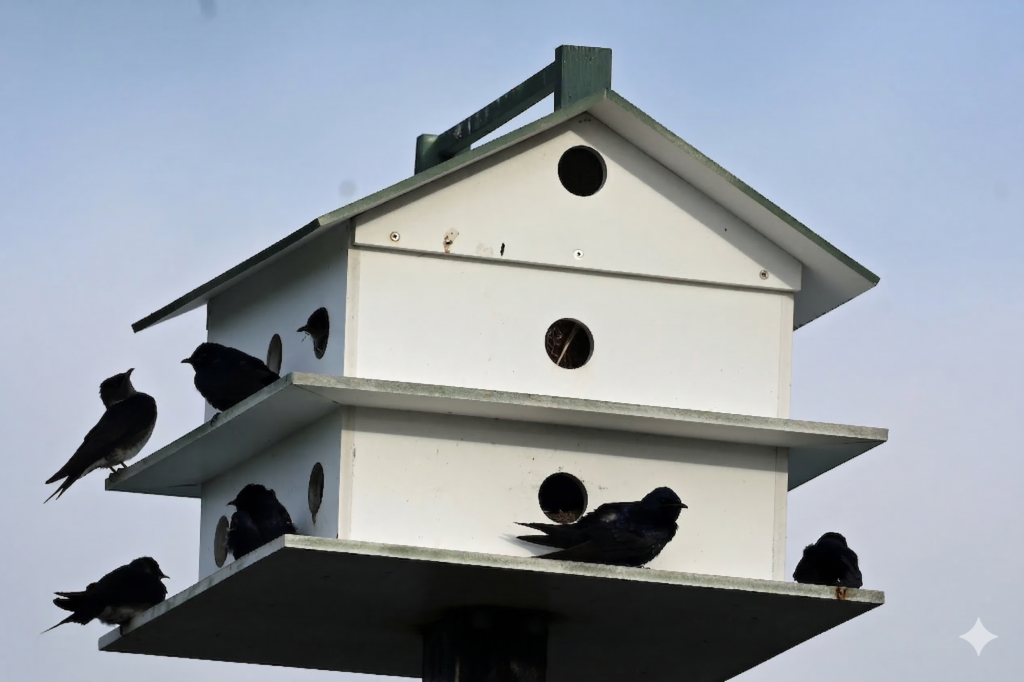

Is Dawn Song Effective for Attracting Purple Martin Scouts?
Unlike many songbirds that sing to defend territory, the Purple Martin dawn song is a specific, complex series of chirps and gurgles performed by older (ASY – After Second Year) males to recruit other martins to the colony.
Evidence for the effectiveness of “dawn song” (or “dawn singing”) in attracting Purple Martins is primarily documented through field experiments involving acoustic playback and the anecdotal observations of hundreds of purple martin enthusiasts seeing bird callers bringing in birds.
Acoustic Playback Experiments
The most direct evidence comes from the widespread success ofacoustic attraction. Ornithologists and “landlords” (people who host martin colonies) have used recorded dawn songs to establish new colonies in areas where martins have never nested before.
The Result: Research has shown that sites playing recorded dawn songs are significantly more likely to be investigated by sub-adult martins looking for a first-time home than silent sites.
The Mechanism: Sub-adults interpret the song as a “social cue.” Because Purple Martins are colonial nesters, the song signals that a site is safe, productive, and inhabited by successful older birds.
Sub-Adult Attraction: Studies tracking banded birds show that sub-adults (SY – Second Year) often “prospect” multiple sites. They are disproportionately drawn to sites where an older male is vocalizing, as it reduces the “cost” of finding a suitable nest site themselves. There is varying theories and evidence as to why older male birds invest effort in dawn singing. One study showed they are motivated by adultery as older birds often will mate with the female of younger pairs.
The Lure Evidence: Biologists have analyzed the timing of the dawn song and found it differs from daytime “social” chatter. The song is performed at a very high volume and is designed to carry over long distances. Since martins are diurnal and migrate at high altitudes, the dawn song acts like an acoustic lighthouse, pulling in migrating birds that are passing overhead in the early morning hours.
Behavioral Response to “Chirruping”: The specific structure of the dawn song includes “chirrups” that trigger a behavioral response in other martins. When these recordings are played, resident birds often become more active, and transient birds are seen to drop from the sky and circle the site—a behavior rarely seen at silent, unoccupied sites.
References
Morton, E. S., Forman, L., & Braun, M. (1990). Extrapair fertilizations and the evolution of colonial breeding in purple martins. The Auk, 107(2), 275-283. https://doi.org/10.1093/auk/107.2.275
Extra Pair Fertilizations and the Evolution of Colonial Breeding in Purple Martins Morton ES, Forman S and Bruan M 2008 https://www.jstor.org/stable/4087610
Hagar, J. C. (2020). Western Purple Martin (Progne subis arboricola) Occurrence in Oregon. https://pubs.usgs.gov/of/2020/1130/ofr20201130.pdf
Purple Martin Organisation Recommendations
• The Purple Martin Conservation Association (PMCA) lists dawn song playback as “the most effective attraction tool” for new colony sites.
https://www.purplemartin.org/howtoattract/
• Purple Martin Conservancy and Ellis Bird Farm state that recordings of male dawn song attract migrating birds to the site, helping establish new colonies.
https://ellisnaturecentre.ca/wp-content/uploads/2024/04/puma_fact_sheet_web_posted_oct_27_2016.pdf
These recommendations are based largely on long-term field experience by “martin landlords” and conservation groups, who report higher colonization rates when using playback.