


How do Swifts Find a Nest Site?
The Common Swift (apus apus) is one of the most aerial birds in the world, spending the majority of its life in flight and landing almost exclusively to breed. Because of this lifestyle, swifts must locate and assess nesting sites while flying. Their nesting behaviour is therefore shaped not only by visual inspection of buildings and cliffs but also by acoustic cues—listening for other swifts already occupying nest sites.
Searching for Nest Sites
Common swifts return to their breeding areas in late spring after migrating from sub-Saharan Africa. Experienced adults usually return to the same nesting cavity each year, demonstrating strong site fidelity. Younger birds (scouts) that have not yet bred must search for suitable nesting sites for the first time.
Prospecting Flights
Swifts search for nesting locations by making repeated prospecting flights around potential nesting structures such as:
- Old buildings with holes and access to a larger spsc
- Swift bricks in modern houses
- Swift nest boxes on buildings
- Natural rock cliffs
During these flights, swifts approach small holes or crevices and sometimes briefly cling to surfaces to investigate them. A bird may repeatedly inspect the same building over several days before entering a cavity.
The Role of Listening to Other Swifts
An important factor in nest-site discovery is acoustic information from other swifts.
Swifts are highly vocal, especially around nesting areas, producing characteristic dawn calls. For a bird flying at 40 mph, a 2-inch hole in a brick wall is nearly invisible. The dawn calls act as an “acoustic beacon,” telling prospectors: “This building is habitable; there are successful nests here.”
Young or non-breeding swifts often listen for these calls while flying over urban and rural areas. When they hear active colonies, they are more likely to investigate. The calls indicate that the site is being used by swifts and is safe from potential predators.
As a result, swifts often nest in clusters or colonies, sometimes with dozens of nests in a single building. Social cues therefore play a major role in guiding inexperienced birds toward appropriate nesting sites.
The Selection Ritual: "Banging"
bird flies rapidly toward a potential nest hole, momentarily clings to the vertical surface, or strikes the entrance with its wings before peeling away.
Through this ritual, the swift is testing:
- Occupancy: If a scream is heard from inside the hole in response to the bang, the prospector knows the site is taken.
Physical Dimensions: The bird uses its tactile senses to gauge if the entrance is wide enough for entry but narrow enough for safety
Selecting a Suitable Nest Site
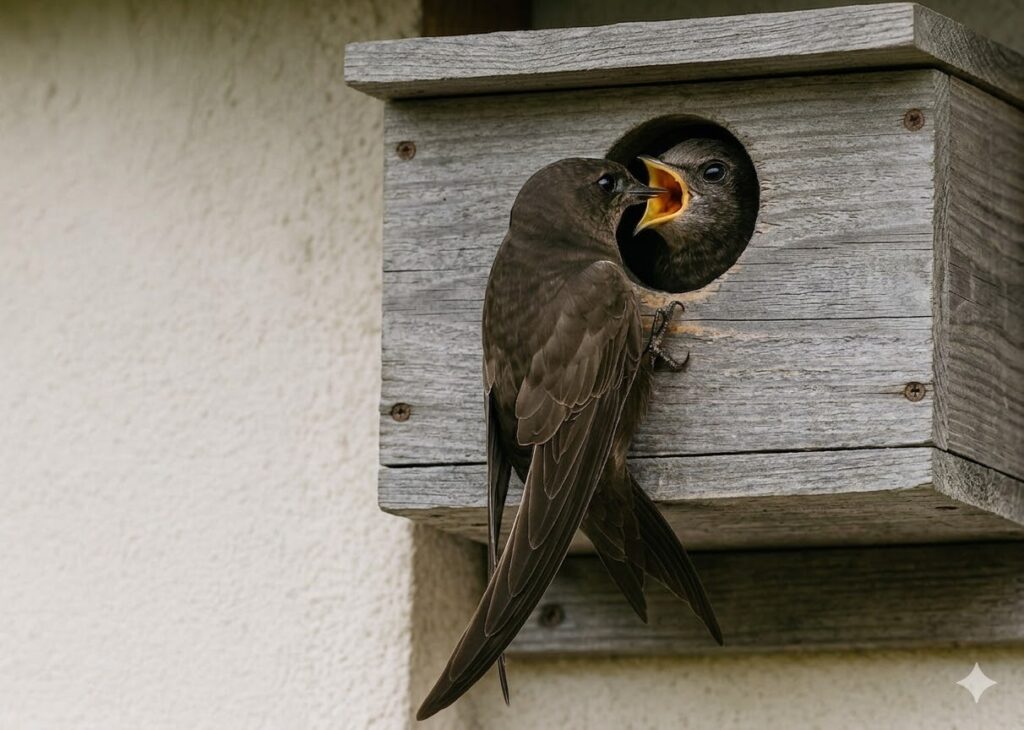
Once a suitable cavity is located, a pair will occupy and defend it. Suitable nest sites usually have:
- A small entrance hole that predators cannot easily reach
- A dark internal cavity with enough space for eggs and chicks
- Protection from rain and strong sunlight
- A stable surface where a nest can be constructed
Competition for these sites can be intense, especially in cities where modern buildings provide fewer cavities than older structures. With the recent serious decline in Swift numbers, swift nest boxes and swift bricks can make an important contribution to their conservation. If you have a new nest box or swift brick, then the chance of getting scouting swifts to discover and nest there is enhanced by using a suitable Swift caller such as Tweeet.